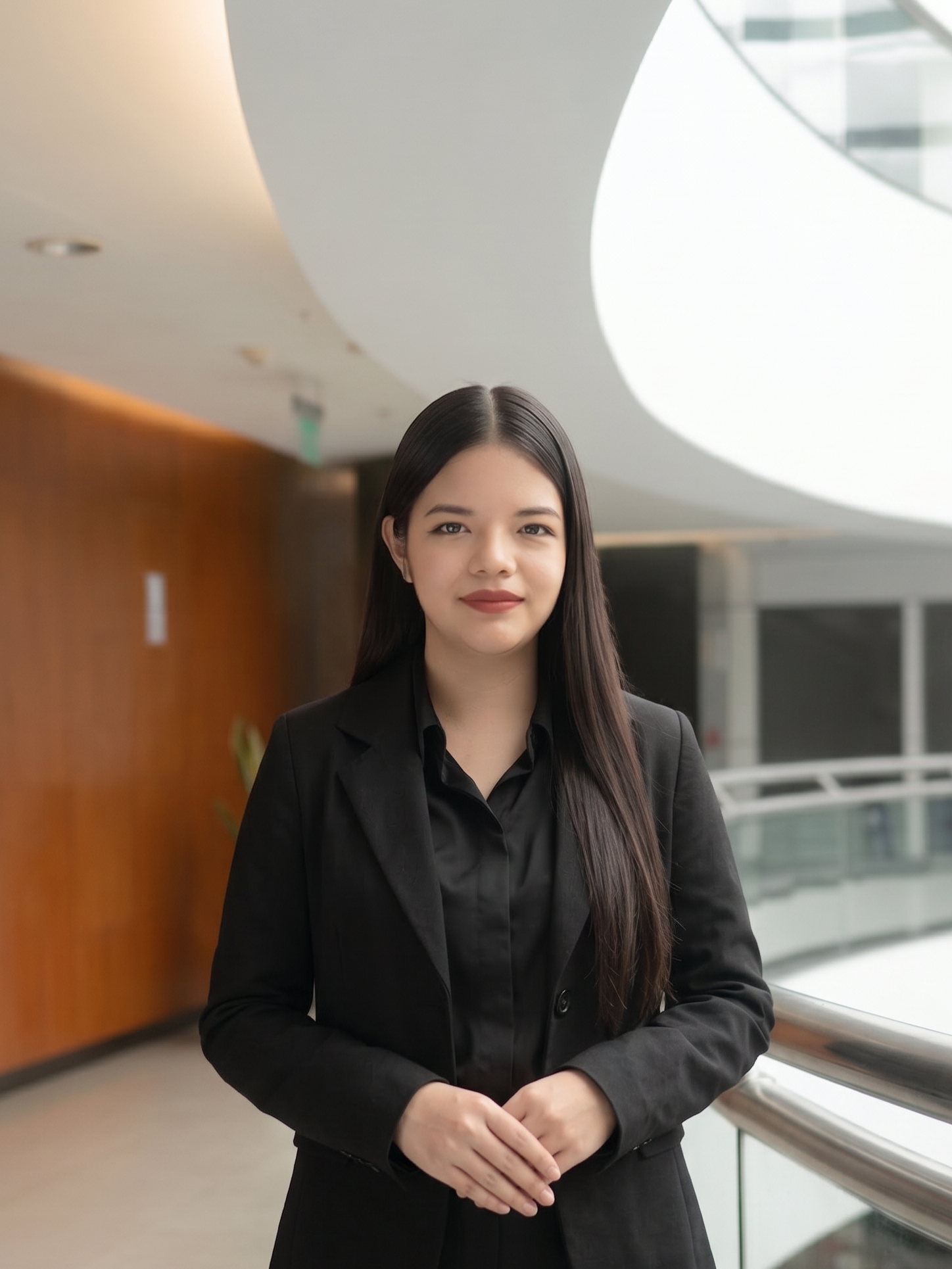
Jasmin Espinoza
Economic Consultant and CCL Alum
What drew you to economics?
What first caught my attention was hearing about economic growth. At the time, I was seeing many challenges in my country, particularly related to poverty and inequality, and I started wondering whether economic growth could be part of the path toward reducing those gaps.
I was also interested in seeing how economics was constantly present in political debates. That made me curious about how economic decisions could influence a country’s development and the opportunities available to its people.
I think that was when I discovered something I particularly liked about economics: it allowed me to study very concrete problems and look for concrete explanations as well. I was drawn to the combination of logic, analysis, and the possibility of using what I learned to understand real-world problems.
Over time, I also discovered that economics was much broader than I had initially imagined. I could study economic growth, innovation, institutions, poverty, development, and many other topics. That breadth eventually became one of the things I valued most about my degree: having different tools to understand the world from different perspectives.
Describe a specific moment when something from Content Creation Lab (CCL) / Global Nomads changed how you saw your own community.
One of the moments I remember most happened while I was working with my team during the Content Creation Lab. We were coordinating a project related to neurodivergence, and we were discussing how this topic was approached in different countries.
It was a conversation that, at first, might have seemed simple, but it changed something important in the way I looked at my own community. It made me realize that the same topic can take very different forms depending on the context in which it develops.
I had been used to thinking about these issues mainly from the perspective of the reality I knew in Peru. However, listening to people from other countries allowed me to discover that policies, public conversations, and even the way certain realities are understood can vary significantly.
It did not mean that one reality was better or worse than another. They were simply different.
After that experience, I started talking about these differences with people around me in Peru. For example, I shared how neurodivergence could be approached differently in other countries and how some topics that may not be very visible in our everyday conversations are already part of public discussions and policies elsewhere.
I think that was one of the main lessons Global Nomads gave me: learning to look at my own community from a broader perspective.
If you had to explain “inclusive leadership” using something that happened recently in your consulting work, what would you use?
In my consulting work, I work with people from different parts of Peru. Each person brings their own experiences, backgrounds, and ways of understanding reality.
For me, that is an opportunity.
When someone encounters a challenge that they cannot solve on their own, the rest of us can contribute from our own experiences and knowledge. It is not only about having one person lead while everyone else follows. It is about leading together, supporting one another, and finding solutions collectively.
So, if I had to explain inclusive leadership, I would say that it is about creating the conditions in which no one has to move forward alone.
Before CCL, I already tried to include people in the spaces and activities I participated in. However, I think I often did it more intuitively. I had the intention to include others, but I did not always know the best way to do it.
CCL helped me understand this idea much more deeply and gave me a more intentional way of thinking about inclusion.
Working with people who, like me, use English as a second language was especially meaningful. Sometimes, it was not simply about finding the right words. We had to pause, listen, ask questions, clarify, and make sure we understood what the other person was trying to communicate.
That taught me that inclusion does not depend only on the person who formally holds a leadership position. Everyone within a team can take the initiative to include, listen, and help others participate.
Then next time, I would like to spend even more time talking to people, asking about their perspectives, and getting to know them beyond the task we are working on. I am a very social person, so I genuinely enjoy understanding what motivates people, how they see things, and what experiences have shaped them. I believe that getting to know people better is also an important part of creating inclusive spaces.
Tell me about a recent time you used a specific skill from CCL with a community you work with.
One of the skills from CCL that I have used the most is adaptation and intercultural coordination.
During CCL, I worked with people who were living in different countries and time zones. There could be one person in Afghanistan, another in the United States, and me in Peru. In order to work together, we had to find schedules that worked for everyone.
It may seem like a small thing, but it taught me that working internationally requires dialogue, flexibility, and a willingness to find common ground.
More recently, I applied this skill in my role as a Senior Coordinator at Students For Liberty and as a blog editor. Part of my work involves meeting with writers to understand their ideas and support the development of their articles.
Although many of these people are also from Latin America and we speak Spanish, our experiences are not necessarily the same. I have had conversations with people from countries such as Venezuela and Chile, and even though we share the same language, we sometimes use different words or have different cultural references.
During these meetings, I try not to assume that my way of understanding something is necessarily the same as the other person’s. I listen, ask questions, and try to understand their context.
The result has been positive. We have been able to coordinate our schedules effectively, develop the content more successfully, and build professional relationships that also become opportunities for mutual learning.
What’s one thing you learned from your financial education project? Can you tell me about the moment you learned it?
In 2025, I participated as an assistant in Cool Earth‘s Reciprocidad pilot project, a basic income initiative responding to the climate crisis and aimed at strengthening Indigenous autonomy. In Peru, the project was developed in partnership with Indigenous organizations such as ONAMIAP and OMIAASEC.
I chose to participate because the project was related to my background in economics, but also because I was deeply interested in its purpose: supporting communities in the Amazon and Central Selva in facing challenges that already affect their lives.
One of the things that impacted me the most was seeing how people decided to use the income they received according to their own priorities.
I remember learning about people who had used part of that income to purchase school materials for their children. That was particularly meaningful to me because it showed that receiving financial resources could go beyond addressing an immediate need; it could also become an investment in a family’s future.
But I learned something that went beyond financial education: people understand their own needs better than anyone else.
When you work on a project from the outside, you can arrive with certain ideas about what should work. But when you speak directly with people, listen to their experiences, and see how they make decisions, you begin to understand reality in a much more concrete way.
One interaction that I remember especially well was with an Indigenous community member whom I will call Rosa. After one of our activities, she hugged me and thanked me for being part of the project.
I did not expect that moment.
I was there doing my work: conducting interviews, collecting information, documenting activities, and supporting the sessions. But apparently, my presence had meant something more to her.
That moment reminded me that behind every dataset, interview, and indicator, there are people with their own stories, decisions, and aspirations.
I also developed several practical skills during the project. I conducted interviews, collected qualitative information, documented activities through photography, and spoke with participants to understand their experiences.
I also had to adapt the way we communicated the financial education content. Some participants spoke Asháninka or Yanesha as their first language and used Spanish as a second language, so we also worked with human translators and adapted some of the materials to make them more relevant to the local context.
This was another moment when I applied something I had learned through CCL: inclusion also means being willing to change the way you communicate something so that it can actually be understood by the person in front of you.
I also learned the importance of active listening. I had to listen carefully during interviews and revisit those conversations afterward to identify insights that might not be visible at a general level, but become clear when you pay attention to the details.
What are you most proud of in your work right now?
Right now, I am involved in several projects that I am very proud of, both professionally and through volunteering.
One of the projects I am most proud of is a civic education initiative that I am currently leading through Patria C. We are developing a program with both in-person and virtual components focused on citizenship, democracy, and youth.
I am proud of it because it represents something I genuinely enjoy: turning an idea into a concrete project and working to make it happen.
At the same time, I am also very proud of my current work in consulting. I am constantly learning and, above all, strengthening my critical and analytical thinking.
I value that a lot because I have always enjoyed learning, academic work, and intellectual challenges.
When I look back at the person I was a few years ago, I can recognize many things I value about her. But I am especially proud of who I am today because I am still learning, still discovering new abilities, and still realizing that I can do much more than I once thought.
I think that is what I am most proud of right now: not feeling that I have reached a final destination, but knowing that I am still learning and discovering what I can do—and how I can use it to contribute to others.