Finding My Perspective Through Storytelling
Stories have been a part of my life since Year 7. After I won second place in an intraschool creative writing competition, I realised that I do have a distinct voice, which I’d spend the next few years learning how to express. That I had things to say doesn’t mean I thought they were worth saying. So, when a friend WhatsApped me a link to a Global Nomads (GN) course and I browsed through the youth opportunities on the website, I was attracted to their mission: students like me raising awareness through storytelling.
Interning with Global Nomads’ Content Creation Lab
Interning with GN’s Content Creation Lab (CCL) twice has been an honour. I co-designed the courses ‘Real Youth, Artificial Intelligence’ from September to December 2024, and ‘Neurodiversity, Leadership, and Belonging‘ from January to May 2025. These experiences satisfied my curiosity—my first internship expanded on the AI ethics I was taught in IGCSE computer science, while my second internship introduced me to new psychological terms—but CCL works differently compared to most academic activities I’ve done. It’s youth-driven. With every intern on an equal footing, there are no mentors and mentees. No judgemental eyes. During the orientation of my first programme, we went through the guidelines we were supposed to follow as interns. The rule, “Share what you know and what you don’t know”, caught my attention, quieting my inner critic. It was less overwhelming to collaborate in the weekly CCL team meetings than, say, debating in a Model United Nations (MUN) conference, where I had to be a composed, eloquent speaker since the stakes were higher. At CCL, I just had to be authentic. The atmosphere was so supportive that I learnt to speak up even—and especially—when I’d stutter or veer off into tangents, rambling, thinking, “What the heck did I mean to say in the first place—no, what’s wrong with my accent?”
Growing Up as a Pakistani in Abu Dhabi
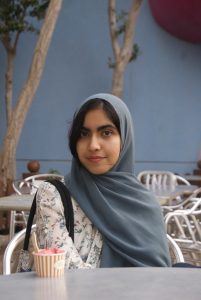
You’d be right if you guessed that my international school background made me a perfectionist. As a Pakistani who grew up in Abu Dhabi, I’m used to breathing in rooms filled with people of different nationalities and social statuses. The school I transferred to in Year 6 was vibrant and, while I met my lifelong friends there, its environment had one downside: competition. So much so that a 91% in a biology final was seen as ‘meh’. As a 4’9 eleven-year-old who needed time to adjust, I initially dreaded speaking to my classmates. Each student was sorted into a group: Triangle (high achievers), Circle or Square (those who needed extra support); when I was placed into Triangle, a girl was shocked. She assumed that because I was quiet, I was a ‘bad’ student—as if that exists! I internalised the misconception that I needed to prove myself in order to claim a seat at the table, but the CCL staff affirmed that being present, listening and engaging with everyone was what defined it.
Learning to Value Accessibility and Inclusion
At school, besides occasional lectures or Culture Day events, diversity was just a fact of my everyday life, as ubiquitous as brushing my teeth. I never thought about what a privilege it is to have lived in a multicultural city until I joined CCL. Since places expose us to the friends, perspectives and opportunities that define us, our stories are deeply shaped by where we were born or raised. CCL, whose entire motto is “by global youth, for global youth”, taught me to recognise and value that context—but our words don’t mean much unless we adjust our systems to make space for different ways of being. I learnt how to translate my appreciation into action by providing me with a useful framework. We implemented tools like backwards mapping and GNG’s accessibility rubric, based on universal design principles, to produce curricula. Really, though, we can apply these techniques to any aspect of our lives, like I did while formatting each issue of Miscellany—an online educational magazine I co-founded with a friend—or creating my social media post as Write the World’s AI Liaison. I followed GNG’s accessibility rubric in both of these roles, using higher contrasts and larger fonts on Canva to accommodate visually impaired readers.
Building Confidence Through Community Involvement
Making learning more accessible for others shifted how I view my presence. I have a memory from Year 3: me, standing in the hallway, watching an older girl—a prefect—stroll by, her high ponytail bouncing. She seemed so… sure. She had that ‘at ease’ aura that I longed to imitate. But participating in CCL programmes (and later representing GNG at two events held by the Charter for Compassion!) brought out that side of me. Once I was given shelter from academic pressure, I learnt to loosen my fist’s grip on perfection. The confidence I admired in others no longer seemed like an impossible state for me to reach, and I nurtured it. I tried things that I was scared to do before, like immersing myself in my school community. I delivered an Islamic general knowledge during an assembly and played a key role in science outreach initiatives, applying CCL’s standard of inclusion in many of them, such as when I mentored Year 6 students in conducting sheep heart dissections safely. Instead of babying them—which would wrongfully assume that they don’t have the capability to understand—I used backwards mapping to break down each step of the procedure. Their small, secretive smiles and relieved sighs as they drew their scalpels through the correct area prove that clear guidance helps students trust themselves, even those as anxious as I was.
Organising a Graduation Ceremony
But accessibility also includes access to opportunities. My time at CCL encouraged me to fill the gaps I spotted in other systems: when my class, the first large post-pandemic Year 13 cohort, learnt that the administration couldn’t fund the graduation ceremony we’d expected, three friends and I took initiative. In our first group discussion, my classmates reluctantly exchanged their opinions, shaking their heads as thoughts clashed: some wanted a dance, some a formal dinner. An Emirati girl quietly asked me, “Would it be a mixed-gender ceremony?” Gathering ideas is easy, I realised; aligning a diverse year group’s visions required the compassionate leadership I’d practiced at CCL—and detailed Google Form surveys. To ensure fairness, we voted for the most popular activities and presented a unified proposal to the principal, trembling. What I’m most proud of isn’t handling the logistics empathetically—searching for budget-friendly venues or designing inclusive invitation cards—but that, by giving agency to those whose ideas were overlooked, I made this once-in-a-lifetime experience accessible for my classmates.
Graduation Day and Realizing Inner Courage
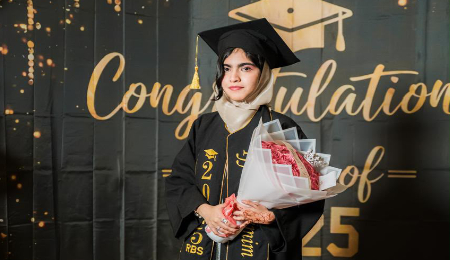
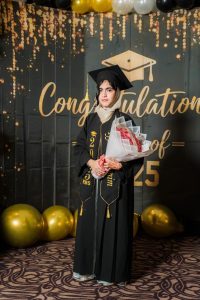
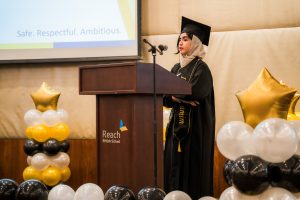
I won’t forget that evening in June 2025. How everyone’s eyes glinted as they received their diplomas and tossed their mortarboards. How our sashes blew in the AC-vent breeze. Because of my contributions to my school community, I was selected to give a speech at our graduation. It didn’t matter that I started bawling mid-speech, even though that was embarrassing. One of my teachers praised my story for being the most emotionally honest she’s ever heard. That mattered more since, without CCL, I wouldn’t have the courage to stand behind a podium.
Discovering Poetry During Gap Year
Today, at 19, I’m on a gap year. One of my main projects is working on my creative portfolio. When I was younger, I prioritised writing prose, although now I’ve discovered that poetry captures the nuances of human stories more precisely. I don’t know what drove me to submit my first poem, then my second, my third, my fourth—but once my longlisting in The Passionfruit Review’s 2025 Poetry Prize cracked the door of the publishing world ajar by a centimeter, I felt determined to squeeze through it. Of course, my Gmail inbox is crammed with “not a fit for us” Submittable notes, a personalised rejection here and there. Just as CCL taught me that my participation is more important than my performance, I’m learning to see rejections as a rite of passage. They’re evidence that I’m showing up, not a measure of my worth, each “no” a necessary step towards the two acceptances I received. If my poetry resonates with someone who can’t find the words to articulate what they’re feeling—like How to Hold West Punjab did with Fahmidan Journal and How a High School Graduate Wins a Game of Uno did with Blue Marble Review—“I shall not live in vain,” to quote Emily Dickinson.
The poem below is a snapshot of my transition from the structured routine of school to the uncertain black hole we call the future. It explores what changes because of time and how genuine connections—I mean, love—survive anyway, one of my recurring literary obsessions.
How a High School Graduate Wins a Game of Uno
Greased-finger girls, fry-and-Uno-card-in-
grip girls, we take turns, smack
worn paper on the plastic grandma-green
of the table, striped fluorescence
cartooning us as laughter-drooling girls.
Vinegar breath, truth
mid-gossip clogs the air. I lean back,
frown, prop a grin duller than the flickering
light overhead. Should I stack that question,
a Draw Four shoved last minute,
smirk Uno—I mean, listen, is this our
last game?
I’m leaving. August’s
got a mouth, gulps my plane on the thirty-first
like a Sprite can,
got fists that’ll drag me to a street
whose diners blur with not-you girls—
you stunned-TV-static girls,
dropping your decks,
shifting closer to hear me right;
listen—
blinking-too-fast-patting-my-hair girls, skin
no longer a soft fifth-grade girl’s,
there’s a sip of fizz left in my cup,
look, not the fog reshuffling at its edge.
This sour fizz. This hand no manual
taught me how to deal: how to breathe
goodbye, girls.
Carrying Content Creation Lab’s Lessons Into the Future
As I navigate my gap year and look forward to university, I carry CCL’s lessons with me. Maybe I can give myself the permission to exist like I am, only two inches taller than I was at eleven, still shy when thrust into new rooms. Maybe I don’t have to be ‘useful’ for others in the “What can I keep tangibly offering them?” sense. Slouching with them, listening to their stories and acknowledging the worth of their voice—that’s useful, too, and maybe it’s what younger Iffah would’ve wanted: to hear and be heard.